
Introduction
Te Horo
Hydrogen Blending Pilot.
What New Zealand proved—and what comes next.
For 16 weeks in 2025, fourteen households in Te Horo on the Kāpiti Coast became the first New Zealand homes to receive hydrogen blended into a natural-gas distribution network. The pilot, led by Firstgas within the Clarus group, progressed from a 3.5% hydrogen blend to 5%, 10% and finally 12% by volume.
The trial was a technical and regulatory success. The existing polyethylene network transported the blend without modification, household appliances continued to operate, no network leaks were detected, no safety incidents were reported and residents were overwhelmingly positive about the experience. The work also contributed to a change in the national reticulated-gas standard, which now provides for hydrogen blends of up to 10% by volume in distribution networks.
Its economic conclusion was much less favourable. A 12% hydrogen blend by volume delivered only about 3% of the gas energy, and renewable hydrogen remained substantially more expensive than natural gas. The final Te Horo pilot report concluded that producing hydrogen specifically for network blending presents a very challenging business case without support mechanisms.
Te Horo therefore answered one important question—can a small hydrogen blend be introduced safely into a representative New Zealand network and used in existing homes?—but it did not establish that widespread household blending is the best or least-cost way to decarbonise New Zealand.
Why the Pilot Was Undertaken
Why the Pilot Was Undertaken
The pilot tested whether a controlled hydrogen blend could use existing infrastructure and household appliances safely under New Zealand conditions.
New Zealand’s gas networks are valuable long-life assets. If renewable gases can use part of that infrastructure, they may preserve energy choice and help supply applications that cannot easily be electrified. International trials had already indicated that modest hydrogen blends could operate in networks and appliances similar to those used here, but differences in regulations, gas composition, materials and installed appliances meant local evidence was still required.
Firstgas began planning the project in 2021 after an earlier feasibility study of New Zealand’s gas infrastructure. It partnered with the country’s other gas distribution businesses—Vector, Powerco, GasNet and Nova Energy—so that the technical, regulatory and community lessons could be shared across the sector. WorkSafe Energy Safety, gas retailers, the Gas Industry Company, Kāpiti Coast District Council, appliance manufacturers, gasfitters, emergency services, mana whenua and local residents were also involved.
Te Horo was chosen after several small networks were assessed. It had fewer than 50 end users, one isolated gas feed, good network records, room for temporary blending equipment and a useful section of pre-1985 polyethylene pipe that could be observed under hydrogen-blend conditions. Fourteen households volunteered to participate.
The Technology Employed
The Technology Employed
A temporary, closely monitored dosing system blended truck-delivered green hydrogen into the network without replacing the pipeline or household appliances.
This was a controlled injection and monitoring project rather than a new pipeline or appliance-replacement programme.
BOC supplied certified green hydrogen produced by electrolysis at its Glenbrook plant. The gas was delivered to Te Horo in portable “manpacks,” each holding approximately nine kilograms of hydrogen in a 15-cylinder frame.
Two manpacks supported the pilot, allowing the small quantity of fuel required to be delivered by truck without permanent onsite hydrogen production.
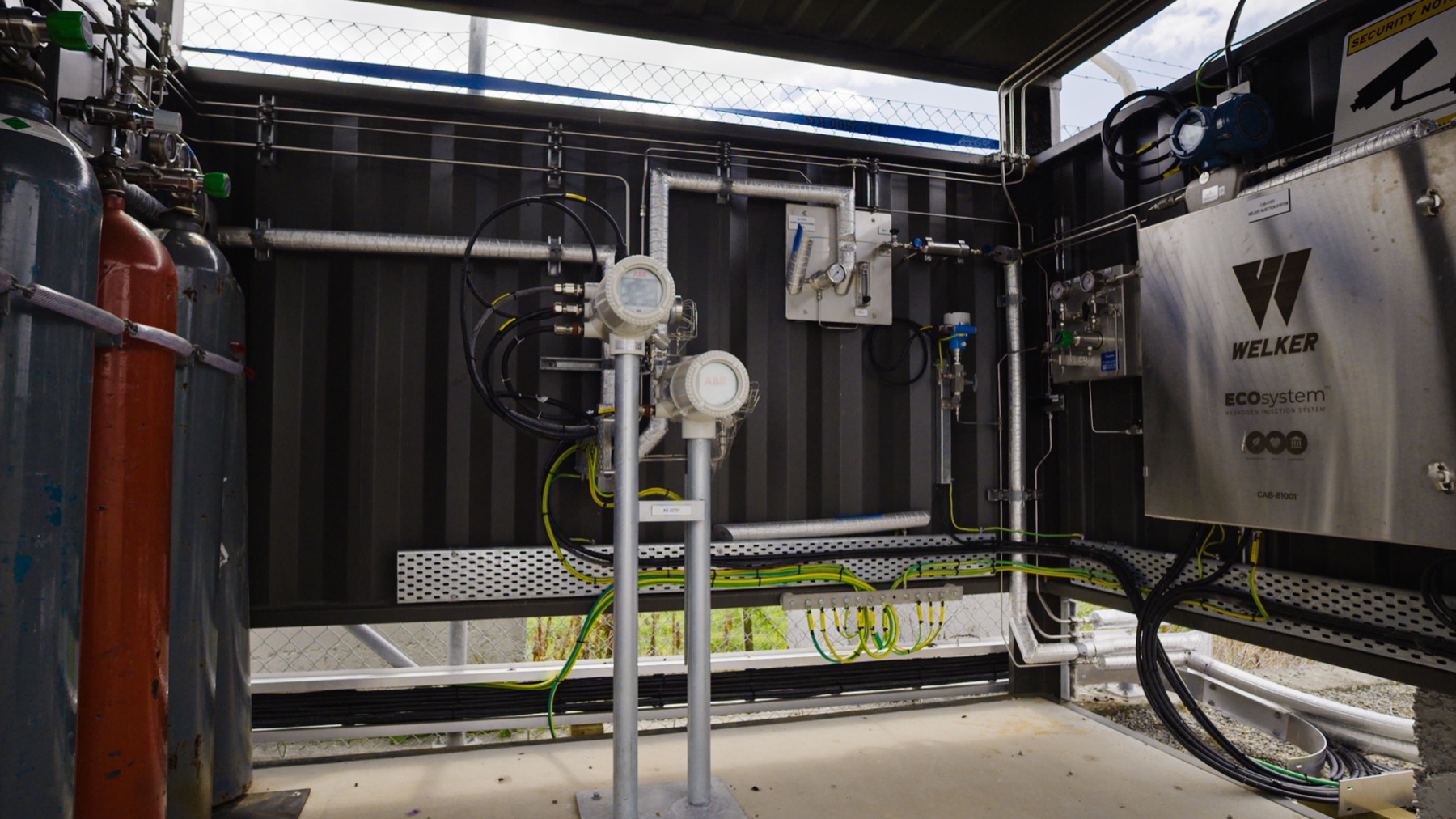
At the Firstgas delivery point on Te Horo Beach Road, a purpose-built Welker dosing package injected hydrogen into the natural-gas stream. The principal equipment included:
- Solenoid-controlled hydrogen injection and a ratio controller;
- Pressure reduction and relief equipment for hydrogen stored above 150 bar;
- Coriolis mass-flow meters measuring both hydrogen and natural gas;
- An injection quill, restriction orifice and mixing tank to produce a consistent blend;
- A continuous online gas chromatograph measuring hydrogen concentration and overall gas composition;
- Programmable controls, remote telemetry and automatic shutdowns; and
- Separate field instruments for detecting hydrogen and natural-gas leakage.
The system operated as a closed loop. It compared the metered flows with downstream gas-chromatograph readings and adjusted hydrogen dosing to maintain the selected concentration. Automatic trips stopped hydrogen injection if composition, flow or Wobbe Index moved outside approved limits. Natural gas continued flowing if the hydrogen equipment shut down, avoiding an interruption to customers.
Most new equipment was installed in two portable containers, simplifying installation and removal. Household appliances were inspected repeatedly, and carbon-monoxide monitors were installed near appliances in every participating home. Gas quality, odorant, network leakage, flames, controls, surface temperatures and selected flue gases were monitored as the blend increased.
The Main Hurdles
The Main Hurdles
The project had to establish a legal pathway, prove network and appliance compatibility, control very small variable flows, remain within gas-quality limits and resolve site and market arrangements.
Creating a Legal Pathway
At the time, the Gas (Safety and Measurement) Regulations required reticulated natural gas to comply with NZS 5442:2008, which limited hydrogen to 0.1 mol%. The supplied hydrogen was also unodorised, although the finished gas in the network still needed to meet odorisation requirements.
Firstgas submitted a detailed application to WorkSafe and ultimately received two time-limited exemptions: one covering gas quality and another covering odorisation. Conditions included staged appliance testing, ongoing monitoring, regular reporting, immediate incident notification and a right for residents to opt out and receive an alternative supply. Establishing the evidence and procedures took several years.
Proving Network and Appliance Compatibility
Hydrogen is a smaller molecule than methane and can escape more readily through unsuitable joints or seals. The network included older polyethylene, while homes contained a variety of cookers, water heaters, boilers and space heaters of different ages and condition.
Australian engineering adviser GPA assessed the network and appliances for blends up to 15%. Gasfitters then inspected every installation and identified appliances requiring extra attention because of age, certification, condition or design. The preparation uncovered several pre-existing safety and maintenance issues—such as defective valves, damaged hoses, incorrect clearances, flue problems and an existing pipe leak—which were repaired before or during the pilot. The report records these as unrelated to the hydrogen blend.
Closed-front flame-effect heaters and some cooker configurations received particular scrutiny. Participants were trained in safe ignition, ventilation was checked and carbon-monoxide alarms were installed.
Controlling a Very Small and Variable Flow
The Te Horo network’s small size made it manageable but technically awkward. At the planned 2% starting blend, the hydrogen flow was too low for stable control, so the first stage was increased to 3.5% with WorkSafe’s agreement. One dead-end sampling point sometimes had too little gas movement to provide a representative sample. A display home was kept in active use partly to support minimum network flow.
Early manual samples appeared to contain excessive oxygen and nitrogen. Investigation showed that air had entered during sampling rather than being present in the network, so steel sampling bottles replaced bags. The laboratory was in New Plymouth, creating additional time and transport constraints for samples collected on the Kāpiti Coast.
Remaining Within Gas-Quality Limits
Hydrogen contains much less energy per unit volume than natural gas. Adding it lowers the Wobbe Index, a measure used to indicate whether gas will deliver compatible heat through an appliance burner. The project originally aimed for 15%, but the composition of incoming natural gas meant the final stage was limited to 12% to remain above the approved lower Wobbe limit.
This was an important practical lesson: a permissible hydrogen percentage cannot always be fixed independently of the base gas. Active composition measurement and control are required.
Consenting, Site Hazards and Commercial Systems
Land-use consent was needed for above-ground equipment and high-pressure piping. Approval took about a year, and because the site was in a modelled ponding area, the temporary containers and hydrogen packs had to be restrained against a flood level of 1.9 metres.
The project also had to solve gas allocation and billing. Hydrogen changed the blend’s volume and energy content, but Te Horo did not have a transmission revenue meter at its delivery point. A new gas type based on the onsite chromatograph was created for retailer billing, while the small hydrogen quantity was treated as positive unaccounted-for gas for industry reconciliation. That simplified approach was acceptable for a short pilot, but a permanent commercial installation would require durable market and metering arrangements.
What Worked
What Worked
Every planned blend stage was completed without a hydrogen-related safety incident, network leak or attributable appliance fault.
The pilot successfully completed every planned blend stage up to the revised 12% maximum and returned the network to normal natural gas afterwards.
Repeated surveys found no leakage at baseline, 3.5%, 5%, 10%, 12% or after the pilot. Gas odorant remained within the applicable limits. The Wobbe Index remained compliant, and WorkSafe’s onsite audit found no issues with compliance with the exemption conditions.
Appliance testing found no wear, damage, control failure or flame abnormality attributable to hydrogen. Residents reported no noticeable change in normal use, and visual inspections found no material change in flame appearance as the blend increased. Selected appliance tests did show an efficiency reduction of approximately 1.5–2% between zero and 12% hydrogen, consistent with hydrogen’s lower volumetric energy content.
No safety incidents or formal notifications occurred. The project cost less than NZ$3 million, which Firstgas considered good value compared with larger overseas trials, because much of the regulatory, engineering and engagement work would have been required regardless of the small number of customers.
A display home fitted with cooking and heating appliances became a valuable testing and education site. It gave regulators, appliance manufacturers, industry representatives and public officials an opportunity to see the blended-gas system operating rather than considering it only through engineering documents.
What Residents Said
What Residents Said
Participating households reported positive experiences and growing confidence in hydrogen, while remaining divided about paying a premium.
Resident acceptance was one of the strongest results, although the sample was small and self-selected. Participation was voluntary, the households were compensated for their time, and Firstgas maintained frequent contact and arranged regular in-home inspections.
The final survey found:
- Every respondent described the experience as positive or very positive;
- 58.3% said the pilot exceeded expectations and 41.7% said it met them;
- 66.7% became more positive about hydrogen, while the remainder reported no change;
- No respondent became more negative;
- All participants agreed or strongly agreed that hydrogen blending was a safe and promising future energy option; and
- 50% were prepared to pay a premium for hydrogen-blended gas, while 50% were not.
Two-thirds gave the highest available satisfaction score. Residents reported stable appliance performance and no significant safety concerns.
These results show the value of early, transparent engagement. They should not be interpreted as a nationwide measure of willingness to adopt or pay. Fourteen volunteers who received close support and compensation are unlikely to represent every household. The split on paying a premium is particularly important: technical acceptance did not remove sensitivity to cost.
The Regulatory Success
The Regulatory Success
The pilot helped provide evidence for a revised national gas standard allowing hydrogen blends of up to 10% by volume in local distribution networks.
On 1 October 2025, Standards New Zealand revised NZS 5442. The 2025 standard now includes provision for up to 10% hydrogen by volume in local gas distribution networks. Clarus attributes the change partly to evidence from the Te Horo project.
The 10% provision applies to injection into local distribution systems operating below 20 barg. It is not a general 10% allowance for higher-pressure transmission pipelines.
This may be the pilot’s most durable achievement. Future projects operating within the standard should not need to recreate the same gas-quality exemption pathway merely to test a blend already covered. Other safety, consenting, hazardous-substance, appliance and commercial obligations will still apply.
The project also produced a reusable body of engineering assessments, monitoring methods, customer agreements, engagement material and operating experience for Vector, Powerco, GasNet, Nova Energy and future project developers.
Other Links
The Central Limitation: Volume Is Not Energy
The Central Limitation: Volume Is Not Energy
A blend percentage by volume overstates its energy and emissions effect because hydrogen contains much less energy per unit volume than natural gas.
A 10% or 12% hydrogen blend sounds like a comparable emissions reduction, but it is not. Hydrogen has roughly one-third of the energy per unit volume of natural gas. Clarus reports that the maximum 12% volume blend represented only about 3% of the energy delivered.
Even if the hydrogen has very low lifecycle emissions, the direct reduction from household gas use is therefore only of that modest order, not 12%. The remaining energy still came principally from fossil natural gas. Small additional effects—such as the measured appliance-efficiency reduction—also need to be included in a full assessment.
Green hydrogen is made from electricity, and using that electricity directly in a heat pump can deliver much more household heat than converting it to hydrogen and burning it in an existing appliance. Network blending also uses a relatively high-value fuel in a low-value heat application when the same hydrogen may have greater decarbonisation value in fertiliser, high-temperature industry, heavy transport or long-duration power.
The pilot report is candid on economics: electricity prices may be too high to support green hydrogen made specifically for gas blending, and permanent blending is likely to remain challenging without financial support.
What Should Happen Next?
What Should Happen Next?
Further work should target representative networks and hydrogen hubs where blending complements higher-value industrial or transport uses.
The technical evidence supports further work, but not an indiscriminate national household rollout.
The next stage should focus on locations where hydrogen production has a stronger primary customer. An industrial hydrogen hub might supply a chemical process, high-temperature heat or heavy transport, with a modest pipeline blend absorbing production that is temporarily surplus or helping establish early demand. This “value stacking” could improve electrolyser and distribution utilisation compared with making expensive hydrogen solely for household combustion.
Any larger pilot should:
- Test a more representative network with higher and more variable flows;
- Include diverse commercial and industrial appliances as well as homes;
- Use permanent-grade metering, allocation and billing arrangements;
- Measure lifecycle greenhouse emissions, hydrogen leakage, nitrogen oxides and appliance efficiency transparently;
- Investigate flexible production linked to new renewable generation;
- Compare costs and emissions directly with electrification, efficiency, biomethane and targeted hydrogen use;
- Retain voluntary, early and well-supported community engagement; and
- Publish independently reviewable operating and economic data.
There is also value in applying the lessons to 100% hydrogen networks intended for specific industrial clusters. A low-percentage household blend proves only part of what would be required. Pure hydrogen would demand a separate assessment of pipelines, valves, meters, burners, appliances, odorisation and emergency procedures; existing household appliances cannot simply be assumed compatible.
Should New Zealand Adopt Hydrogen Blending More Widely?
Should New Zealand Adopt Hydrogen Blending More Widely?
Blending should remain a conditional transitional option rather than a central household decarbonisation strategy.
New Zealand should keep blending available as a strategic and transitional option, but should not currently make mass residential blending a central decarbonisation policy.
The Te Horo trial established that blends within the new 10% standard can be technically manageable in a suitable polyethylene distribution network without changing household appliances. That could help maintain network knowledge, create early hydrogen demand and provide flexibility where low-emissions hydrogen is already being produced for higher-value purposes.
The case for subsidising dedicated green-hydrogen production merely to blend it into household gas is weak. The emissions reduction is small in energy terms, production is costly and direct electrification is normally much more efficient for domestic heating and cooking. Biomethane may also integrate more readily with existing gas equipment because it is chemically interchangeable with natural gas, though its sustainable supply is limited and must be evaluated separately.
Further adoption should consequently be conditional. It should proceed where a project demonstrates verified low-emissions hydrogen, a credible source of affordable supply, material system benefits and better value than available alternatives. Consumers must receive clear information that blended gas remains predominantly natural gas and is not a zero-carbon product.
The Lessons from Te Horo
The Lessons from Te Horo
Te Horo showed that careful engineering, dynamic gas-quality control, appliance inspection and transparent community engagement are all essential.
The pilot leaves New Zealand with several practical lessons.
First, small hydrogen blends can be carried safely through at least the tested type of distribution network when they are carefully engineered, monitored and regulated.
Second, existing appliances may operate normally at these concentrations, but inspection and maintenance remain essential; the project uncovered numerous unrelated faults that might otherwise have gone unnoticed.
Third, gas quality is dynamic. Hydrogen dosing must respond to network flow and incoming natural-gas composition rather than relying on a fixed percentage.
Fourth, sampling technique, laboratory access, odorisation, billing and local site hazards are as important as the central injection technology.
Fifth, public confidence can be built through choice, transparency and visible safeguards. Te Horo’s voluntary participation, compensation, display home and frequent communication were central to its positive reception.
Finally, technical feasibility does not equal economic or environmental optimality. Te Horo proved that blending can work. It also showed why the best future role is likely to be targeted: modest blends connected to wider hydrogen hubs and hard-to-electrify users, not hydrogen made at high cost simply to preserve business-as-usual household gas consumption.
This is a valuable conclusion. A good pilot does not have to justify immediate mass adoption; it should replace assumptions with evidence. Te Horo has given New Zealand a tested technical pathway, a more enabling standard and a much clearer basis for deciding where hydrogen in gas networks may—and may not—be worthwhile.